TIKKURILANTORI
A SOUND INSTALLATION IN VANTAA CITY MUSEUM
30.8.2024 – 9.3.2025
IMPRESSIONS ON TIKKURILANTORI
BY SANNA LEHTINEN
Audio installation by Students from Vantaan sanataidekoulu – Literary Art School of Vantaa & researchers of the transitory writing in no one’s land project
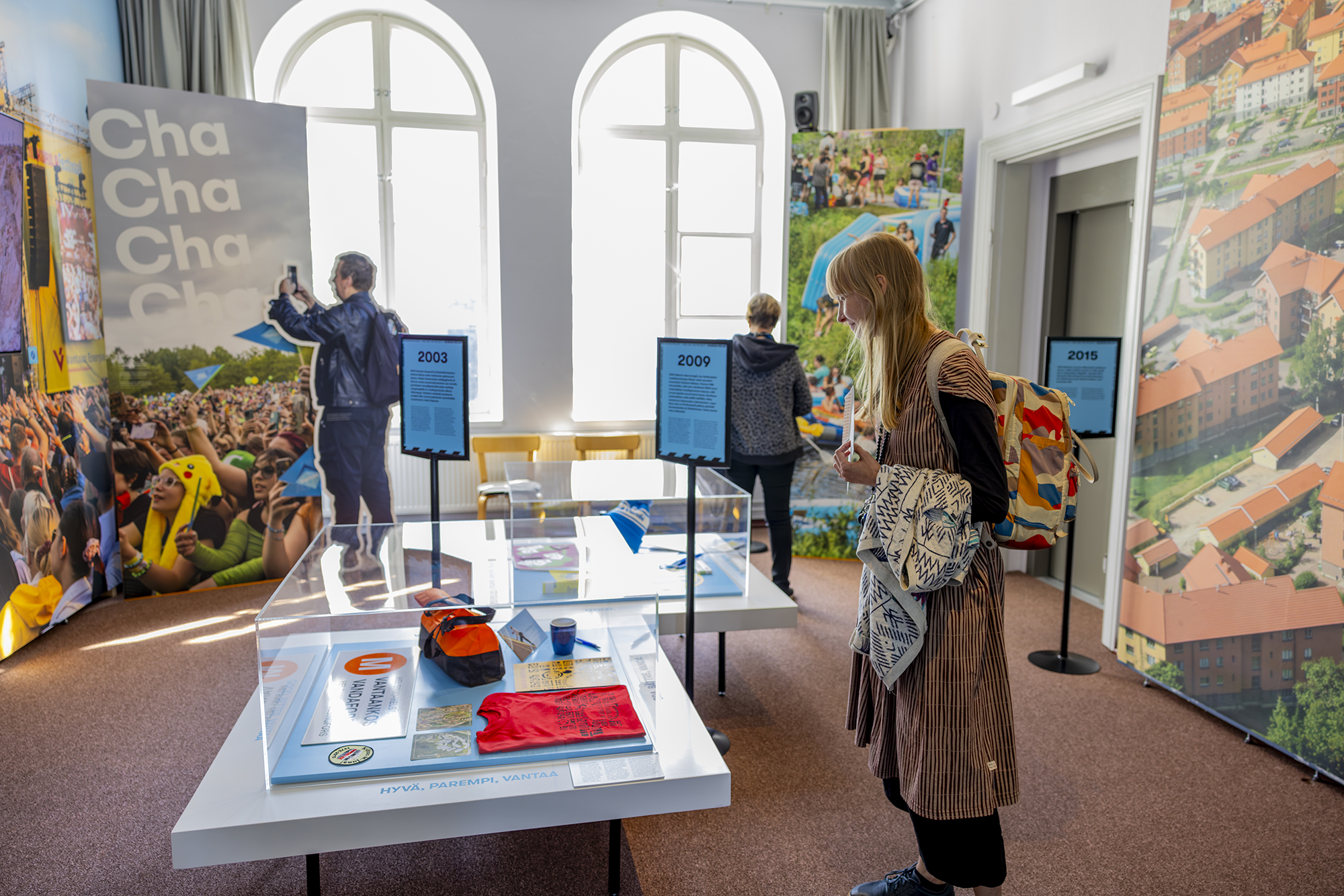
Public space is public for the very reason that it carries within it the opportunity for every urban dweller to have space for their actions and their voices to be heard. Tikkurilantori (2024) is a collaborative work that connects to the experience of a particular public square, the Tikkurilantori or Tikkurila market square in Vantaa, by turning observations of bodily perceptions into words, these textual accounts into recorded readings, and editing them into a multilingual audio installation with a duration of 35 minutes. The work is a joint collaboration between Vantaan sanataidekoulu – Literary Art School of Vantaa and researchers of the transitory writing in no one’s land project funded by the Kone Foundation. The Tikkurilantori piece is accessible as part of the Vantaa City Museum’s exhibition Good, Better Vantaa, in the form of an audio installation in a room that focuses on the 21st century perspectives on life in Vantaa. The placement of the work underlines its contemporary aspect; that the sounds that we hear, the things, people, and actions turned into words, are from our very own times, not from a more or less distant past.
On a first impression, Tikkurilantori reminds its audience of sound as a decidedly central part of the urban experience. One does not merely look, watch, or glance, let alone smell, touch, or taste what happens in any given space. Hearing and listening to the work reminds me of that we do actively so also when being out and about as urban dwellers. The perceptive stance is an active state: it starts
with an alert body, the senses are operating when something raises attention, sometimes even at their peak when being attentive at or to the square. The participants made bodily observations at the square being attuned to their senses, turned them into words, following instructions or rather invitations in the workshops leading to the concluding artwork. This change in modality from the sensory into the affective verbal expression turns elements of the city into newly charged nodes of perceptual tension: what has happened or been there available for the senses, is turned into words and then into material in an artistic research process leading up to an artwork.
When engaging in the workshop, the time of observation was set on five consecutive Fridays in May, a lively time in any public space in Finland. The work week is over for many, people are on the move, families taking a stroll — the weekend in the public space of any city is usually welcomed with a frenzied hustle. Nonetheless, not everything is on the flux out there. Fixed objects and the setting or backdrop for action on the square stay put. In this artwork building on languaging, nouns are partly avoided, objects do not need to be named directly, and focussed descriptions point towards the necessary cues for their further identification.
On a second impression, one explicit intention of Tikkurilantori is to nudge its listeners to continue the artwork as they walk out of the museum building. In the same urban location that has provoked the words, it is possible to continue observing and paying attention to objects, agents, soundscapes, temperatures, and events on any day or time of the day. According to philosophical urban aesthetics, anything big or small can be followed by conscious observation and intentional contemplation if it is available to the senses in the shared urban space. The things one stays attentive to can be experienced on a wide scale of interests, and one can decide to delay one’s judgment and try to observe without evaluation. Sometimes a seemingly uninteresting impression can then gain importance or vice versa; the city and our impressions of it are contextual and prone to change. Other people, for example, affect whether a moment in time in the public square feels accommodating or not.
On a third impression, the ambiguous meanings of Tikkurilantori bring forth the senselessness of human action in the exceedingly contested public space of the contemporary city. Without clear cues towards a single interpretation, Tikkurilantori challenges its audience to linger with the words, their tone and bearings, to peek into the simultaneously existing possible worlds they carve. At times, one feels almost like an eavesdropper of archived situations one would not have otherwise noticed. Through verbal documentation one becomes a witness to the events and relations between people and the square. This testimonial is at the same time a flexible monument of the place, condensing to half an hour so much of what happens outside the museum walls, in the very city its carefully curated exhibitions strive to portray. The present moment is the most difficult to grasp since its closeness makes it blurry. Distance brings clarity as it allows conceptualization, although often with loss at the fuzzy edges. By double distancing, Tikkurilantori turns its audience into both observers and protagonists of their everyday. This gesture folds the experience of the audio installation into the city, and equally expands a view upon the role and character of Tikkurila outside of the museum walls into the city itself.
On a final impression, besides its most obvious content layer, the project team invites audiences through Tikkurilantori to have a peek into collaborative writing and the interesting contemporary forms it can take. The square itself writes with the participants through what it reveals as careful, methodological, and repeated observations. Dynamics between different styles and languages, paces and rhythms carve a multitude of voices out of a single place. In this, it is similar to the city itself.
 writinginpublic.space